

The Prosperity Problem for Conservatism
and the solution to fix it


In my last post, I explored some of the basic definitions of what it means to be Conservative. In this post, I want to explore a perennial problem for Conservatives: The Prosperity Problem.
What is the Prosperity Problem?
The Prosperity Problem occurs when a particular society becomes so prosperous that it begins to intentionally reject its heritage. The story goes something like this: after several generations of working to build a civilization, that civilization eventually becomes prosperous enough that the next generation can live in relative peace. This younger generation, born of peace, then begins to reject the cultural norms of their forefathers, finding these norms quaint or old-fashioned. As they reject the established norms, the society upon which those norms are built begins to crumble.
Such a situation can only occur in a relatively free, prosperous, and peaceful society. When a society is free, prosperous, and peaceful, it has the opportunity for both leisure and amusement. Amusement, being easier than leisure, will win the day unless a society actively fight against it. Amusement, which intentionally moves the mind away from important things, will eventually create a stupid people.
Prosperity and Amusement
To muse is to think about something. Amusement, then, is to not think about something. Amusement is often done to entertain. It is fun, a little escapist, and allows us to experience something pleasant while not thinking about the important things.
Amusement is not a bad thing. I’m not sure anyone could spend all of their time deeply pondering things. I am a professional philosopher, and I don’t spend all of my time pondering. To do so is not only impossible, but it would probably drive one to madness, too.
At the same time, amusement is much like Skittles: it is fun, it feels good, but it is not long-lasting. Assuming you could continuously eat Skittles and not feel sick from the sugar, you would have to eat a lot of them before you began to feel full. And, even if you reached that point, the feeling of fullness would not last long. Soon, even with a belly full of Skittles, you would start to feel hungry again.
A good Steak, on the other hand, is like engaging with good literature or music. It doesn’t take much steak before the stomach starts to feel full and heavy. Try as you might, you can only take so much before you need to do something else. It fills you up! Sometimes the best thing to do after reading something like Plato or listening to Beethoven is to engage in some amusement.
Amusement is an excellent tool for rest. The problem comes in that, like sugar, it can begin to function as a drug. Amusement is not ultimately satisfying, and we are left wanting more and more and more. We get to a point where we work in order to pay for our amusements rather than using amusement as a short rest from work (and leisure). Without discipline, amusement can quickly become the tail that wags the dog.
Prosperity lends itself to a culture of amusement. By creating an environment where we have money and opportunity, we simply have greater access to amusement than when we are poor and required to work.
Money and opportunity, though, do not necessitate amusement. And, if they do not necessitate amusement, they don’t necessitate the Prosperity Problem, either. How do we go, then, from point A to point B? What about our success actually leads to the overindulgence in amusement that creates the Prosperity Problem?
Tradition and Leisure
I would argue that one of the main reasons prosperity leads to amusement is the lack of leisure. But wait, isn’t leisure just another form of amusement? Doesn’t that mean the same thing?
Not quite.
In colloquial terms, we often use “leisure” to refer to activities such as entertainment or amusement. In its historical context, however, leisure meant something more akin to “restful learning,” or “rested contemplation.” Leisure occurred when one would sit back (perhaps with a pipe in hand) and ponder the world, contemplating great ideas. Leisure was a form of musing rather than a-musing.
Traditions, especially the Great Western Tradition, are the kinds of things that require contemplation. They cannot simply be assumed or adopted.
The American world is the multifaceted product of the Great Western Tradition. It is born out of the convergence of ideas coming from thinkers like Plato, Aristotle, Cicero, Augustine, Aquinas, Martin Luther, John Calvin, Montesquieu, “Junius Brutus,” and John Locke. America was made great because it was founded upon ideals drawn from some of the greatest thinkers in human history.
One cannot maintain the status quo of greatness if one does not know or understand these thinkers and their works.
Leisure, then, is quite difficult. When one is born into a hard world, leisure, the contemplation of the world that allows one to thrive in the world, is a highly sought-after human activity. When one is born into a prosperous world, on the other hand, leisure is not as necessary. The world seems as though it does not need to be overcome. Things are good and they will always be good…right? Why not simply enjoy the fruits of all that laboring?
Prosperous societies, given the ease of life created, do not feel the need for leisure in quite the same way as less-prosperous societies. The irony, of course, is that subbing leisure for amusement will eventually destroy the prosperous foundations that gave rise to the culture of amusement in the first place.
In order for a tradition, and the prosperity it created, to survive, we must make room to leisurely ponder that tradition rather than simply amusing ourselves.
The Conservative Burden
G. Michael Hopf is credited with the idea that there is a cycle that occurs when societies are built:
Hard times create strong men
Strong men create good times
Good times create weak men
Weak men create hard times
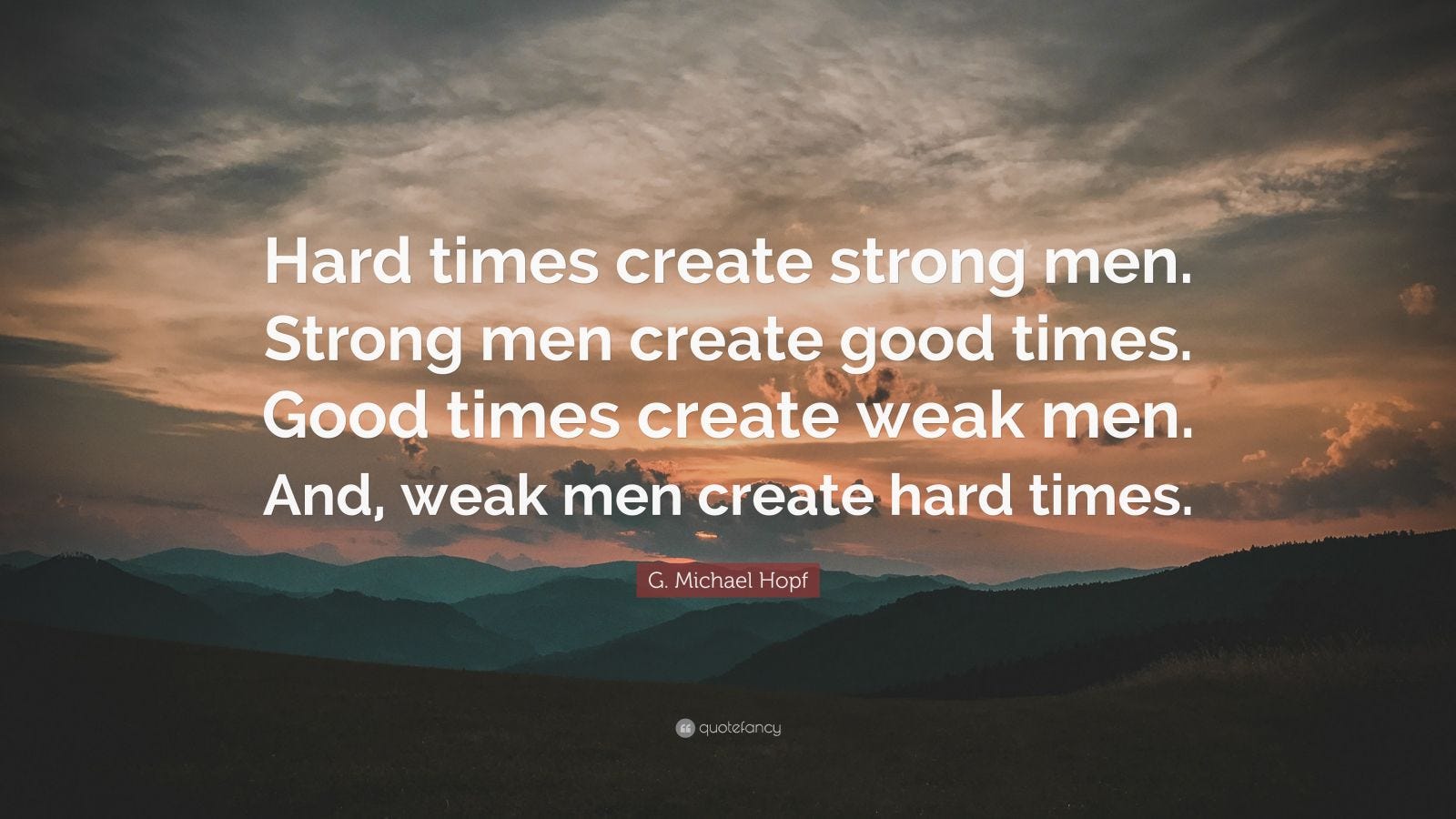
In other words, a society is largely built by “strong” men. These are the men who have worked and sacrificed to create a particular kind of world, usually one that is aimed at prosperity. As they create this society, the Prosperity Problem begins to take effect, creating the weak men who eventually break such a society. But what makes men “weak”? Not physical softness, but the replacement of leisure with amusement; the choice to be entertained rather than educated, distracted rather than contemplative.
This is where the rub lies. The very prosperity that past generations of conservatives worked to create becomes the mechanism by which their successors forget why that prosperity exists in the first place. We inherit wealth, freedom, and peace—but without the leisure to contemplate how these goods came to be, we cannot maintain them. We become like heirs who squander an inheritance because we never learned the family business.
For parents and educators in the classical tradition, this means more than simply exposing children to great books. It means modeling a life that values contemplation over consumption, choosing the steak over the Skittles, even when the Skittles are readily available and infinitely more convenient.
The Prosperity Problem is not inevitable. Prosperity creates the opportunity for amusement to overtake leisure, but it does not necessitate it. What it requires from us is intentionality—the deliberate choice to engage in the hard work of thinking rather than the easy escape of not-thinking.
Our prosperity was built by those who engaged in leisure. It will be maintained only if we do the same. The great irony is that leisure—true contemplative rest—requires more discipline than amusement. But it’s the only discipline that preserves what’s worth conserving.
Recommended Reads:
In Defense of Tradition by Richard Weaver
The Conservative Mind by Russell Kirk
The Founders’ Key by Larry Arnn
Love What Lasts by Joshua Gibbs